• Home
  • Get in touch
  • Log in
  • Resources
    • Outcome Monitoring
    • Mental Health PROMs
    • Physical Health PROMs
    • PREMS
  • More
    • Home
    • Get in touch
    • Log in
    • Resources
      • Outcome Monitoring
      • Mental Health PROMs
      • Physical Health PROMs
      • PREMS
  • Home
  • Get in touch
  • Log in
  • Resources
    • Outcome Monitoring
    • Mental Health PROMs
    • Physical Health PROMs
    • PREMS

Better data. Better decisions. Better outcomes.

Routine Outcome and Patient Experience Monitoring

Routine Outcome Monitoring

Routine Outcome Monitoring (ROM) - also referred to as Patient-Reported Outcome Measures (PROMs), Measurement-Based Care (MBC), Feedback-Informed Treatment (FIT), and Measurement Feedback Systems (MFS)—is the practice of systematically collecting and using patient-reported data to guide care. While terminology varies by setting and discipline, all refer to the same core principle: making patient progress visible and actionable in real time to improve outcomes.

Patient Experience Measures

Patient Experience Measures (PREMs) capture how patients perceive and experience their care, including communication, involvement, and the quality of the therapeutic relationship. The process of reviewing and discussing this experience (of the treatment, the practitioner, and/or the service itself) is referred to as Feedback-Informed Treatment (FIT), Deliberate Practice, Patient or Client Experience Measures, Satisfaction Surveys, or Net Promoter Score (NPS). While terminology varies, all PREMs share a common purpose: capturing the patient’s experience of care to strengthen engagement, improve service quality, and inform better clinical and organisational decision-making.

The Evidence and Role in Health Care

1. Improve Treatment Outcomes

The process of regularly administering, reviewing, and responding to PROMs and PREMs has been shown to improve outcomes and accelerate progress, with better results achieved more quickly. By making patient progress and experience visible in real time, this enables earlier identification of those who are not improving or are deteriorating, allowing for more timely and effective intervention.

A psychologist sits with a client, taking notes on a clipboard while listening

2. Reduce Patient Turnover

Giving patients a voice and actively involving them in their treatment is not only empowering but also improves engagement - leading to higher treatment completion rates, reduced cancellations, and fewer premature dropouts. By making patient progress visible in real time, it also helps optimise practitioner diaries, reduce unused appointments, and ensure the right patients are seen at the right time - ultimately improving access and reducing waiting times for care.
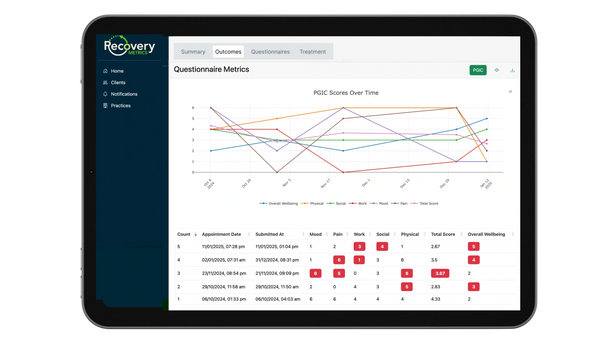
Tablet displaying outcomes dashboard with progress graphs and patient questionnaire scores over time

3. Meet Compliance and Reporting Requirements

Recovery Metrics supports clinicians to meet increasing third-party and regulatory requirements (e.g., WorkCover/WorkSafe, NDIS, Medicare, and private insurers in Australia, as well as National Health Service (NHS), IAPT/Talking Therapies, and private payers in the UK). With growing expectations to demonstrate treatment effectiveness, maintain accurate clinical documentation, and evidence quality of care under professional standards and codes of conduct, many practitioners lack the tools to efficiently capture, track, and report outcomes.

A clinician sits at a desk, holding their head with both hands, conveying stress

4. Give Clinicians Their Time Back

Practitioners don’t have the tools required to support this, leading to increased administrative burden, compliance risk, reduced billable time, missed third-party payments, and increased practitioner burnout.

By providing a solution that automates and integrates these processes, clinicians gain valuable time back to focus on delivering care, increase their capacity to see more clients, improve utilisation of practitioner diaries, and ultimately help reduce waiting times for treatment.

Mental Health Measures

Laptop displaying client measurements, questionnaire metrics, and charts showing progress over time.
Learn More

Physical Health Measures

Tablet displaying a clinical dashboard with questionnaire metrics, line graphs of progress, and a ta
Learn More

We acknowledge the traditional owners and custodians of the land on which we work as the first people of this country.

  • Home
  • Get in touch
  • Log in

Copyright © 2023 Recovery Metrics

This website uses cookies.

We use cookies to analyze website traffic and optimize your website experience. By accepting our use of cookies, your data will be aggregated with all other user data.

Accept